
Date24.09.26
Location Europe
Conference
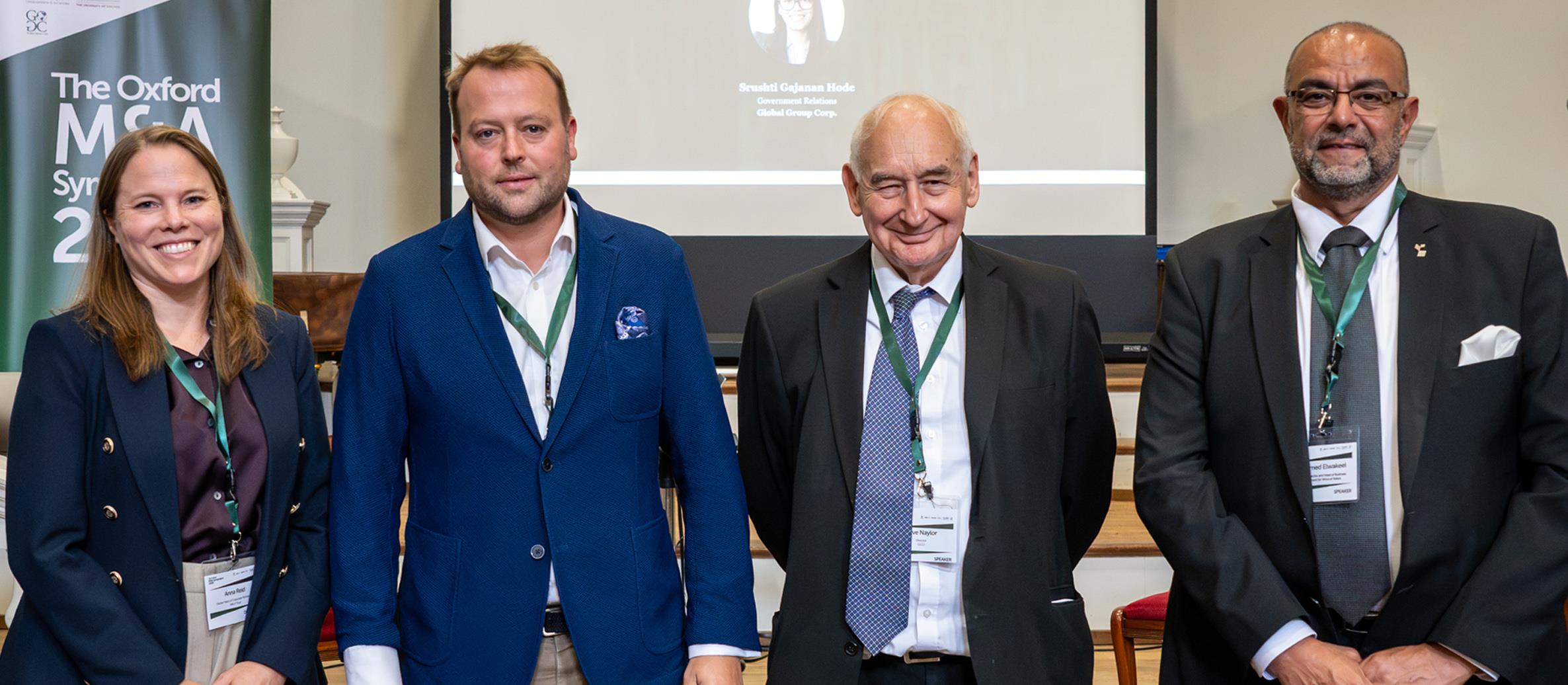
On 16 September 2026, Dar and Sidara's UK Managing Director, Daniel Horner, and Associate Director - Business Development, Mohamed Elwakeel, participated as panellists in the Reconstruction Models for Post-Conflict Regions session at the Oxford M&A Symposium 2026, held at Wadham College, University of Oxford.
The session formed part of a series of five discussions dedicated to post-conflict reconstruction, covering the Geopolitical Economy for Post-conflict Geo-strategy, the Reconstruction Models for Post-Conflict Economies, Capital Deployment, Trading with Post-Conflict Regions and Financing Models for Post-Conflict Regions. The symposium was sponsored by Jesus College, University of Oxford, JEN, BANCOR, Institute for Mergers, Acquisitions and Alliances, POLSKY and GGC.
Drawing on three decades of experience, Mohamed shared lessons from Dar and Sidara's reconstruction programmes and projects across Lebanon, Iraq, Angola and Libya, as well as ongoing work in Syria. He highlighted how reconstruction methodologies and technologies have evolved, emphasising the importance of a coordinated, context-sensitive approach to rebuilding post-conflict regions. He identified several factors critical to successful programme and project delivery:
- Sustained commitment from the international community and the availability of funding.
- The removal of sanctions and restrictions that prevent the import of essential equipment.
- The capabilities of local authorities and their role in supporting reconstruction efforts.
- Engagement with local communities to understand and address their needs.
- Experienced urban planners and strong engineering consortia with expertise and willingness to operate in post-conflict environments.
- Effective rubble management, supported by appropriate security and logistical arrangements for programme and project teams.
Expanding on rubble management, Mohamed outlined the process from risk clearance and segregation to processing, material reuse and upcycling, highlighting its importance to the wider reconstruction effort.
Building on the operational challenges and reconstruction methodologies discussed by Mohamed, Daniel shared insights into initiatives that Sidara is exploring with universities around the world. These involve using artificial intelligence, drones and robotics for surveying, data collection and rubble quantity estimation, with the aim of accelerating post-conflict site clearance and reducing risks to human life. By making site clearance safer and more efficient, such approaches could help communities begin rebuilding sooner, while supporting the recovery and reuse of materials.
Daniel also highlighted the importance of urban planning in reconstruction, emphasising the need to integrate strategic vision with community-led action. At the community level, prefabricated and modular construction techniques can empower local people to participate actively in rebuilding, supported by clear urban design guidelines, building codes and quality standards.
At the strategic level, a visionary yet viable masterplan should establish a roadmap and investment framework for reconstruction and sustainable growth. This can help attract capital, build investor confidence and coordinate infrastructure and development priorities, while ensuring that investment responds to local needs and creates lasting opportunities for communities.
These perspectives highlighted the importance of combining practical reconstruction experience, emerging technologies and long-term planning to address both the immediate and future needs of communities affected by conflict.
We are delighted to have been invited by GGC to contribute to this meaningful exchange of knowledge and perspectives and appreciate the opportunity to be part of such valuable dialogue.