
Date05.11.26
Location Africa
Event
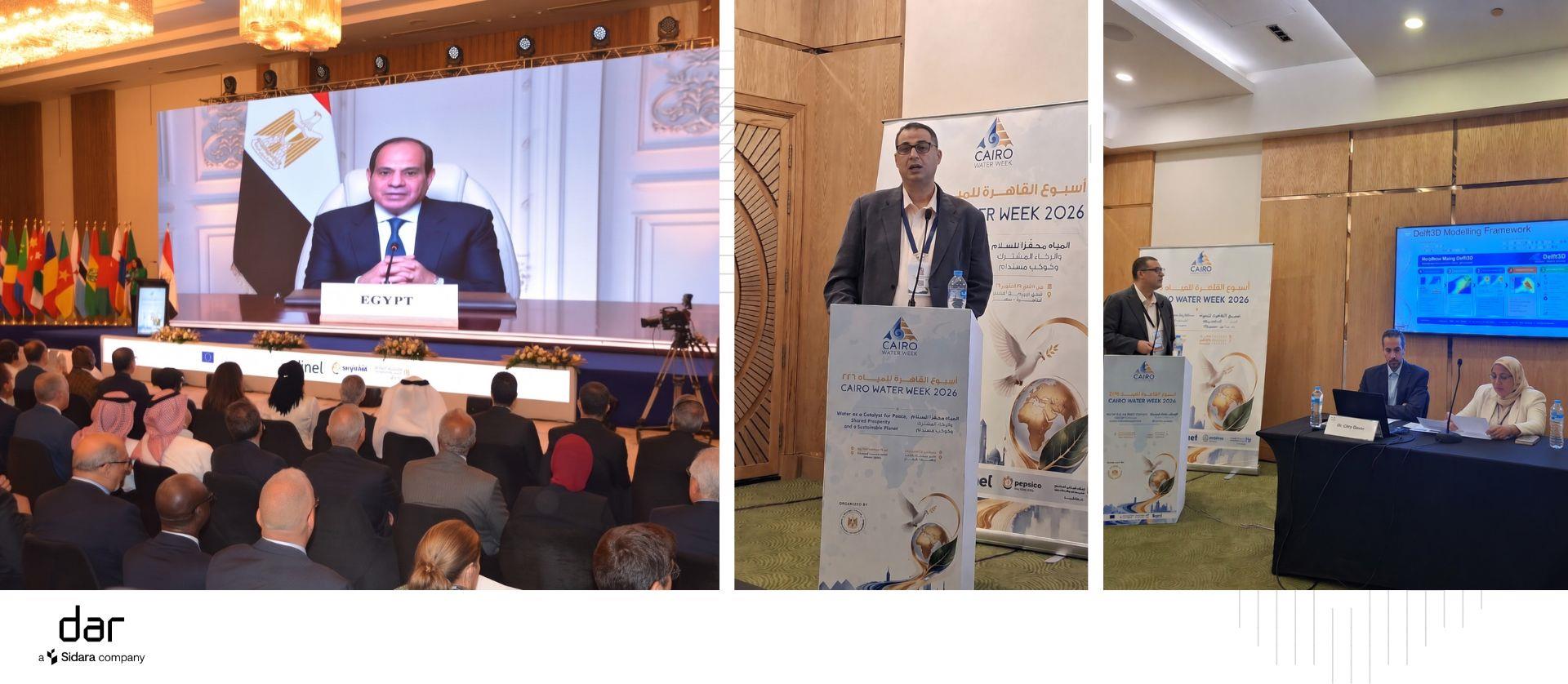
Held under the auspices of H.E. President Abdel Fattah El-Sisi, President of the Arab Republic of Egypt, the ninth edition of Cairo Water Week took place from 25 to 29 October 2026, under the theme, “Water as a Catalyst for: Peace, Shared Prosperity, and a Sustainable Planet.”
Established as a prominent international platform for dialogue, knowledge exchange, and collaboration, Cairo Water Week provides a forum for policymakers, water leaders, researchers, engineers, international organisations, and industry experts to address pressing global challenges related to water security, climate resilience, and sustainable development.
Dar's participation in this international forum reflects its continued commitment to advancing innovative and climate-resilient engineering solutions, while sharing practical knowledge and experience gained through the delivery of complex infrastructure projects across different geographical and environmental settings.
During the conference, Dr. Ahmed Sayed Mohamed, Associate Principal Coastal Engineer in Dar's Geotechnical and Heavy Civil Engineering Department, presented the paper “Application of Numerical Modelling for Estuarine Infrastructure Design: Lessons from Nigeria and Tanzania”, under Theme 3: Enhancing Climate Resilience through Sustainable Water Resources and Coastal Zone Management Solutions.
Drawing on practical experience from the Brass River Estuary in Nigeria and the Mtwara Estuary in Tanzania, the paper demonstrated how advanced marine numerical modelling can support the planning and design of major coastal, marine, and waterfront infrastructure.
The research highlights the importance of well-calibrated numerical models, supported by field measurements, in developing a reliable understanding of complex estuarine processes. By simulating the interactions between tides, river discharges, currents, sediment dynamics, storm surge, and future sea-level conditions, this modelling approach provides a sound technical basis for assessing both existing and extreme environmental conditions. This is particularly important in estuaries, where critical conditions for infrastructure design can result from several physical processes acting together rather than from a single environmental factor.
Beyond their analytical function, appropriately developed, calibrated, and validated marine numerical models provide an evidence-based framework for translating complex coastal and estuarine processes into design-relevant engineering parameters. When used from the early stages of infrastructure planning and design, alongside reliable field observations and clearly defined present-day and future environmental conditions, these models help engineers assess extreme water levels and currents, the risk of erosion around infrastructure, changes in seabed and shoreline conditions, as well as navigation and dredging requirements.
This integrated approach helps reduce uncertainty, establish reliable design parameters, and support sound engineering decisions. It also contributes to the development of coastal and marine infrastructure that can withstand existing environmental conditions and the evolving impacts of climate change, including storm surge and sea-level rise.
Presenting this work at Cairo Water Week 2026 provided a valuable opportunity to showcase Dar's capabilities in coastal and marine engineering, advanced numerical modelling, and climate-resilient infrastructure design. It also demonstrated how experience gained through Dar's projects across Africa can inform wider discussions on sustainable development, climate adaptation, and the resilience of critical coastal infrastructure.
Ultimately, the research reinforces a fundamental principle: reliable marine infrastructure design requires an understanding of environmental extremes and the complex interactions between the physical processes that generate them. By integrating high-quality field data, well-calibrated numerical models, and sound engineering judgement, Dar continues to strengthen the technical foundation for the development of safe, sustainable, and climate-resilient coastal and marine infrastructure.